
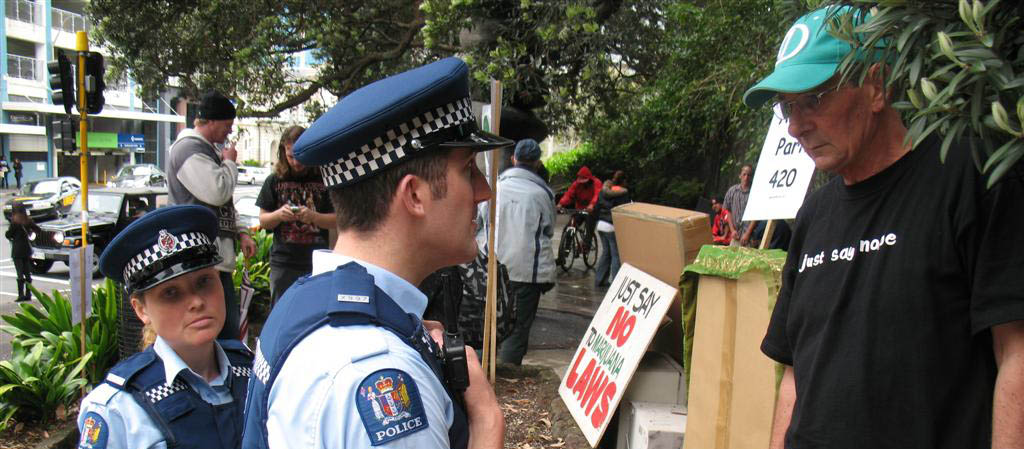
NORML’s guide on this page is provided in the context of being suspected of committing a crime, rather than just walking down the street. It is general in nature. Your situation may be different. You should seek proper legal advice from your lawyer or your local Community Law center.
Statement for Police – keep it handy!
Officer, if I am under arrest or being detained, please tell me so.
If I am free to go, please tell me so. If I am not free to go, please tell me why.
I wish to exercise all my legal rights including my right to silence and my right to speak to a lawyer before I say anything to you.
I do not consent to be searched. I wish to be released without delay.
Please do not ask me questions, because I will not willingly talk to you until I speak to a lawyer.
Thank you for respecting my rights.Download here (pdf business card sized)
Police Questioning
Be calm and don’t get smart to the police. You have the right to remain silent – including written statements – other than giving your name, address, and if in an age-sensitive situation, your date of birth. You don’t have to go anywhere with police unless arrested. Not even a ‘just come over here so I can talk to you.’
You have the right to speak to a free lawyer on the Bill of Rights list. If you are under 17 you have the right to have a supportive adult with you at the station.
Searches
Police can search you, your bag or car if (a) you let them, (b) they arrest you, (c) they have a search warrant, or (d) they have reasonable grounds to believe you have drugs on you (this could include smelling or seeing drugs or seeing you using drugs) and they invoke the Misuse of Drugs Act (MDA) section 18 subsection ii (property) or iii (person). They must tell you if they are using this search power. Silence is taken to be consent, so if you do not want to be searched, say:
No, I do not consent to a search. What is your lawful authority?
Ask their reason for thinking you were using or have drugs. If they invoke the MDA they must file a report with the Police Commissioner within 72 hours, and you have the right to obtain a copy of this report. You have the right to watch them search. You have the right to a witness.
The police can search your home if (a) you consent, (b) they have a valid search warrant, or (c) they have reasonable grounds to believe there are drugs there and invoke the MDA.
They can only search inside your mouth if you agree. You can only be searched internally (and only by a doctor) if the police have arrested you and they have reasonable grounds to believe you have drugs inside you. If you are female then only a female officer can search you. Police must let you know their name & badge number if they arrest you.
Driving
An officer can stop any car at any time to check for warrant, registration etc. You and your passengers have the right to remain silent, but must give your names, dates of birth, addresses and the registered owner of the car. The driver can be detained for up to 15 minutes to establish identity.
An officer can search your car if
- you agree, or
- they have reasonable grounds to believe there are drugs in the car and invoke the Misuse of Drugs Act s18, or
- they have a search warrant, or
- they arrest you and you’re with your vehicle at the time, or
- under the Crimes Act police can search any car and its occupants for stolen property.
Any driver can be breath-tested for alcohol. If the driver appears intoxicated and passes a breath test, the police officer can order the driver perform a Roadside Field Sobriety Test, which involves tasks such as:
- balancing on one leg,
- walking a straight line,
- accurately estimating when 30 seconds have elapsed
- Officers also measure pupil dilation and reaction to bright light
If in their opinion a driver has failed this series of ‘tests’, the officer can detain them to take a blood sample. The presence of any amount of illicit drugs is an offense.
THC will remain in the blood for 2-3 hours after use – so wait 3-4 hours before driving. Use the NORML-developed iPhone App to check if you are impaired. Unfortunately heavy or regular users may always have some THC in their blood even if not under the effect.
See also – Guide to Drug Testing
At School
From the Youthlaw website:
You are being searched if anyone goes through your bag or your possessions in order to find something, or checks for items on your body or in your clothing. You are also being searched if someone looks at information you have stored electronically, such as on your phone or computer. You are not being searched if someone simply looks at you and sees, for example, that you are carrying a knife.
The law says that everyone is protected from unreasonable searches from government, which includes from schools and teachers.
The school should tell you about their specific policies on searches.
- Are teachers allowed to search me?
- What rules do teachers have to follow when searching me?
- Can a teacher take my property?
- Can the police search me at school?
- My parents have agreed with my school that I can be searched – is this allowed?
- Can teachers search my locker?
- What if I’ve signed a contract allowing the school to search me?
- Can I be searched before a school ball or school function?
- Is the school allowed to search everyone?
- What about sniffer dogs?
For more help and information, contact Youthlaw Project on 0800-884529 or see www.youthlaw.co.nz
At the Station
If you are arrested, you must go with them. Ask for your lawyer or another from the Bill of Rights list. Don’t be videoed, don’t make deals, don’t nark. You must give your name, address, date and place of birth, and occupation – nothing else. You have the right to NOT make a statement, and the police must inform you of this. You have the right to know the nature and cause of the charge, at the time of arrest. You have the right to consult a lawyer.
In Court
You have the right to see all evidence they have against you before your trial – ask for ‘full disclosure’ of ALL the evidence they have. Make them work for a conviction – they may not have much of a case, they may have searched you illegally, or they may have made mistakes that could see the evidence thrown out – but only if you contest it.
Cannabis laws are harsh and unjust. New Zealand has the world’s highest cannabis arrest rate, with 16,500 offenses recorded by Police in 2012. On average, around 200 people are imprisoned every year just for using or possession cannabis – with the average sentence 49 days.
Maximum penalties under current NZ drug law (Misuse of Drugs Act 1975):
- Use, consume or possess cannabis: 3 months jail and/or $500 fine
- Possess a pipe, bong or utensil: 1 year jail and/or $1000 fine
- Grow your own cannabis: 2 years jail
- Sell or give cannabis to someone else: 8 years jail
Acts of civil disobedience such as the ‘Roaring Lion’ approach are affective ways to help change the law – and may help get your case thrown out.
- The Dumb Lamb meekly offers their throat to the butcher’s knife, mindlessly going where directed and doing like the police say and pleads “guilty” to get it over and done with. It’s you that’s getting done, while the police get a nice easy conviction.
- The Stubborn Mule resists every step of the way, making the police and court work for a conviction. First appearance: enter “no plea” and seek legal advice. Second Appearance: Say you refuse to recognise the charge, because you don’t think you’ve committed a crime. The court will likely enter a “not guilty” plea on your behalf. Third Appearance: tell the judge exactly why you think the law stinks, in the politest possible way. The penalty for the Mule is not going to be more than for the Lamb, and often will be less, but you cost the system heaps and kept your self-respect.
- The Roaring Lion is proud, and staunch with it. The Lion goes through the court process in the same way as the Mule, but takes non-cooperation that stage further. They tell the judge that they will not pay a fine, or do PD. If the court is determined to punish them, it will have to send them to jail, putting strain on an already full up prison system. The more we clog up their system, the less it will be able to cope.
Complaints
Write down everything that happens, and get any witnesses to do the same. Take photos of any injuries. You can make a formal complaint to the Independent Police Complaints Authority, PO Box 5025 Wellington, Freephone 0800 503 728. Further information: www.ipca.govt.nz
Legal advice
See NORML’s list of suggested lawyers.
You can also try searching for lawyers:
- The Criminal Bar Association
- The Law Society register of lawyers
- The NZ Law Society
- Legal aid lawyers: www.lsa.govt.nz/general/search
- Human Rights Lawyers Association NZ: http://www.hrla.org.nz/
Community law centres provide different sorts of services to those of conventional law firms. They provide free legal advice to communities with unmet legal need, especially those unable to pay for legal services. This may involve legal representation. For local contact details see: www.lsa.govt.nz/general/community.htm
Under 25? Youth Law Tino Rangatiratanga Taitamariki provides a free confidential legal advice service for young people under 25 yrs. Call toll free 0800-884529 or see www.youthlaw.co.nz